
Marker Balls for Gas, Water & Sewer: Color-Coded Damage Prevention
By Victor | Mocbo · Blog Article · Focus: gas water sewer marker ball
Not all utility strikes are equal. A sliced telecom line is an outage; a struck gas line is an explosion risk, and a ruptured water or sewer main floods a street and contaminates soil. For gas, water, and sewer, the cost of a mislocate is physical and environmental - not just financial. That is why permanent, color-coded marker balls are a core part of safe excavation.
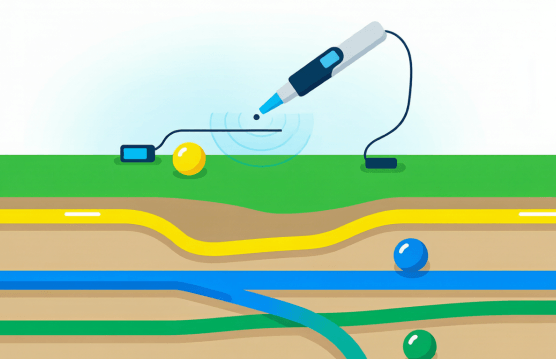
APWA Colors for Buried Utilities
The APWA Uniform Color Code is the U.S. standard that tells a locator what is below at a glance. For the three below-ground utilities:
| Color | Utility |
|---|---|
| Yellow | Gas, oil, steam, petroleum |
| Blue | Potable (drinking) water |
| Green | Sewer and drain lines |
Why Gas, Water & Sewer Need Permanent Marks
- High consequence. Gas strikes risk fire and injury; water/sewer breaks cause flooding and contamination.
- Safety compliance. Damage-prevention programs and 811 rules push for reliable, identifiable marking.
- Environmental protection. A sewer or water rupture has cleanup costs that dwarf the price of a marker.
- Ownership changes. A permanent mark survives contractor and utility-owner turnover.
- Standard EMS frequencies, reads on Dynatel and compatible locators.
- IP68 sealed, about 50-year design life, battery-free.
- Self-leveling coil for reliable detection.
- ISO 9001 / 45001 / 14001 certified, 65,000 pcs/month capacity.
Matching Marker Color to Facility
| You are marking | Use color | Common frequency band |
|---|---|---|
| Gas / oil line | Yellow | Gas band |
| Potable water main | Blue | Water band |
| Sewer / drain | Green | Sewer band |
Match the color to the facility - never to the project. A gas line gets yellow even if the project also touches fiber.
Damage Prevention Economics
The U.S. records roughly 840,000 underground utility damages per year, with economic losses above $30 billion. Telecom is the largest share of incidents (~49%, driven by 5G/broadband buildout), but gas and water strikes carry the highest per-event consequence. Permanent electronic marking is the cheapest insurance against the severe ones.
Mocbo Full Color Set
Mocbo MB22 passive marker balls cover the standard EMS frequency plan, including the yellow (gas), blue (water), and green (sewer) bands - so distributors and municipalities can build a complete, color-coded marking program from one certified source.
Frequently Asked Questions
What color is a gas line marker ball?
Yellow, per the APWA Uniform Color Code. It is tuned to the gas EMS frequency band.
Can one marker serve gas, water, and sewer?
No. Each marker is tuned to one frequency/color. Mark each facility with its correct color-coded marker.
Are marker balls required for compliance?
Permanent electronic marking supports frequency/color-coded identification aligned with utility-marking practice; always follow your local 811 and asset-owner specifications.
Why not just use surface paint for gas lines?
Paint fades in days or weeks and disappears under paving. A buried marker stays locatable for decades - critical when the consequence of a strike is high.
Does Mocbo also supply Safety Clothing fabric?
Mocbo's core production is passive EMS marker balls (MB22) for telecom, utility, and distribution customers. Our ISO 9001 / 45001 / 14001 quality system also supports industrial textile sourcing for field crews, including Safety Clothing fabric.
About Mocbo
Mocbo manufactures passive EMS marker balls (MB22) covering the standard frequency set for gas, water, sewer, and telecom, with ISO 9001 / 45001 / 14001 certified production.